The Moment
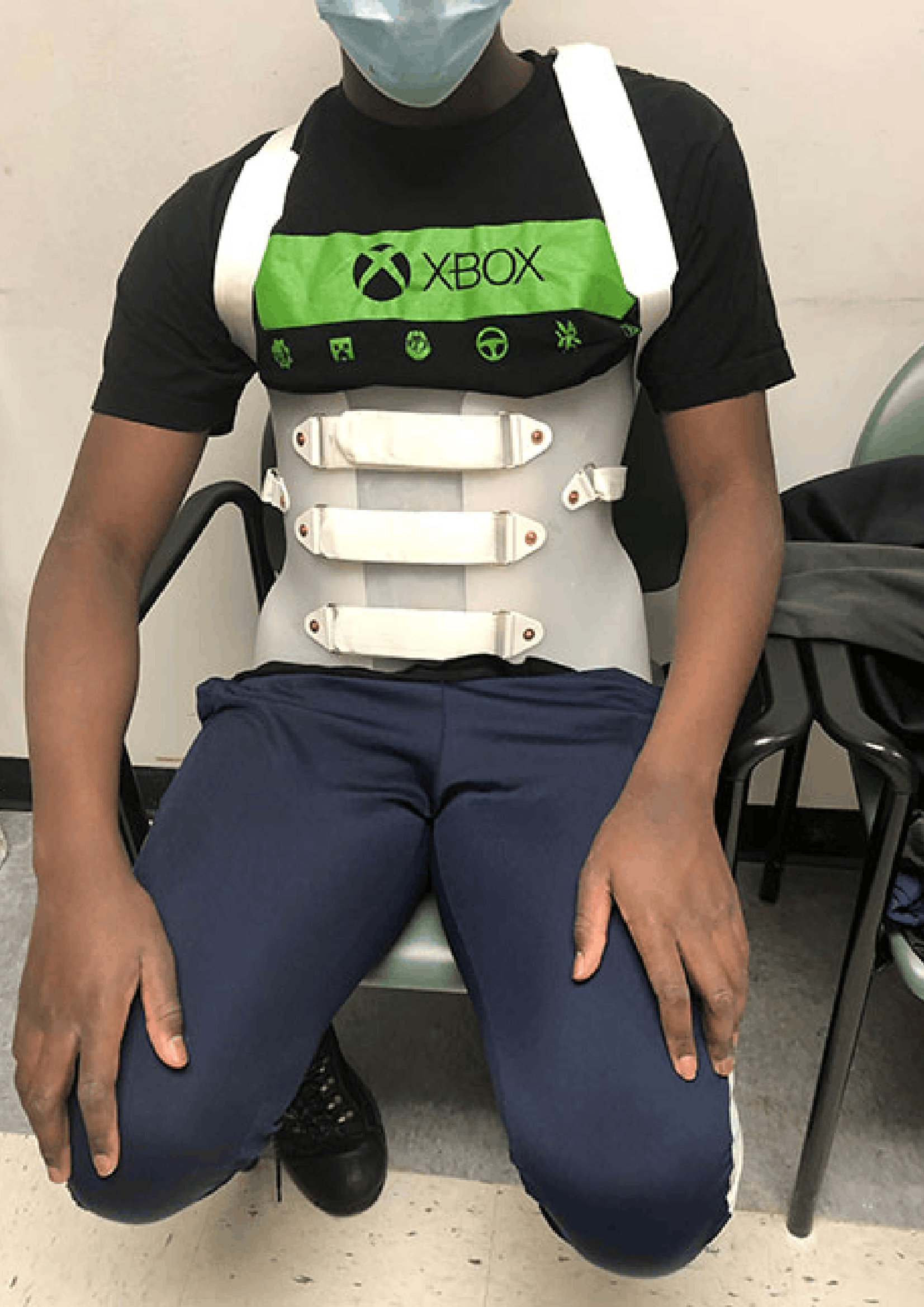
An image of discipline, teenage resilience, and targeted spinal orthotics: 17-year-old Marcus stands tall, confidently wearing his custom-moulded scoliosis brace over a thin interface shirt. As he prepares for his final year of college, this image captures the reality of conservative spinal treatment, where medical necessity meets the daily lifestyle of an active young adult.
Behind the Lens: The Orthotic Strategy
Managing a spinal curve in a 17-year-old male presents distinct biomechanical and clinical challenges. Because spinal growth plates (Risser sign) are nearing maturity at this age, the orthotist must apply precise forces to hold or correct the curve:
Three-Point Pressure System
The orthotist uses a physical cast to design a rigid thermoplastic jacket. It strategically places corrective pressure pads over the apex of the spinal curve, while leaving empty "relief areas" opposite the pads so the spine can migrate into alignment.
Rotational Correction
Modern scoliosis braces do not just push the spine from the side; they are engineered with derotation principles to address the three-dimensional twisting of the rib cage and vertebrae.
Low-Profile Design
To encourage compliance, the orthotist contours the brace carefully under the arms and over the hips. This ensures it remains discreetly hidden under standard clothing, allowing Marcus to maintain his social routine without feeling self-conscious.
Overcoming the Compliance Hurdle
The success of any scoliosis brace depends entirely on wear-time, often requiring 16 to 23 hours of daily use. For a 17-year-old, this demands immense mental strength.
The orthotist's role extends beyond manufacturing; it involves acting as a supportive partner. By involving Marcus in the design process , such as selecting the brace finish and discussing his daily sports activities, the clinical team ensures the orthosis fits seamlessly into his life rather than restricting it.
Orthotic intervention for scoliosis is a race against skeletal maturity. By successfully managing the spinal curve during these final growth stages, the orthotist helps Marcus avoid invasive spinal fusion surgery, reduces long-term back pain, and ensures he enters adulthood with a balanced, strong posture.